Wednesday, February 11, 2015

Another Winning Season

The Syracuse win over Boston College was an enjoyable game, and different than what Orange fans have become accustomed to.  Syracuse has not had too many walk-away wins this year, and this game really was never in doubt over the last 6-7 minutes with the Orange winning 70-56.

The game did have a historical perspective to it.  The win moves the Orange record to 16-8 for the year, and with only seven games left on the schedule because of the post-season ban, it guarantees the Orange another winning season.  

We take winning for granted in Syracuse, as the Orange have not had a losing season since 1968-1969 when the team went 8-16.   That is 46 seasons of winning basketball.  The school has only had sixteen losing seasons ever, and the program started in 1900-1901.  I am not sure which basketball program has the longest streak right now for consecutive winning seasons, but 46 is very impressive. 

For perspective, remember that Duke, one of the best programs out there, had a losing season in 1994-1995.  Mike Krzyzewski also had losing seasons in 1981-1982 and 1982-1983 with Duke.  Kansas was 13-16 in 1982-1983.  North Carolina was 8-20 in 2001-2002.  Georgetown was 13-15 in 2003-2004.  UConn was 9-19 in 1986-1987. Kentucky was 13-19 in 1988-1989.  

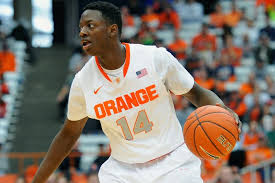
Kaleb Joseph had a coming out party tonight!  He was aggressive to the hoop, and went 7 for 7 from the floor for 14 points.  Welcome Kaleb!

B.J. Johnson also got some significant playing time and made some three point shots. He hit four of twelve, on his way for 12 points for the night.  That shooting is not going to break any records, but considering how poorly he has been shooting, that was very nice to see.

Michael Gbinije continues to play at a very high level.  8 of 11 from the floor for 21 points, coupled with 7 rebounds and 4 assists.  Gbinije has been extremely impressive as of late.

Rak Christmas was handcuffed tonight by several double and triple teams, and he ended up with only 7 points, though he did get 10 rebounds and 3 nice blocks.


Let’s go Orange!

Wednesday, February 04, 2015

Syracuse Self Imposes Ban for 2015 Post Season

Syracuse University announced today that it is self-imposing a ban on all post season activity for its men's basketball program for this year.  The ban includes the NCAA, NIT and the ACC tournament.

It is a shame that the current roster of players has to suffer for the misdeeds done in the past.  I do not know all the details of this particular investigation, though I have been flustered by what I already know.  Syracuse self-reported academic violations by Feb Melo and James Southerland at the time they occurred.  Melo was suspended first by the university and then later in the season by the NCAA.  The Melo suspension in 2012 was extremely impactful on the Orange as the team was ranked #2 in the country, and one of the top favorites to win the tourney. Without Melo they were talented enough to make a run to the Elite Eight.

Part of me feels like there is double jeopardy in this situation. The punishment was handed out, and the program suffered at the time.

Again, there are probably more issues at hand than what I am aware of.  I will be curious to see what those may be.

The self-imposed ban from the ACC tournament seems excessive.  When Syracuse was banned in 1993 by the NCAA, it was still permitted to play in the Big East Tournament.  So the Syracuse administration is dolling out a very stiff penalty on itself.

The move is definitely self-serving by the university; I am not naive to that. This year's team was not going to have a strong post season, and they are hoping that sacrificing this year will allow the team not to be impacted for next year, nor have any lingering impact on recruiting.   The 1992-1993 ban took a couple of years to get announced, and there were recruits the Orangemen lost as a result.

I do find the NCAA to be a capricious and inconsistent organization.  There does not seem to be any predictable pattern to penalties they dole out, nor which institutions get investigated in the first place.  It seems clear that some programs are cheating academically because practically it seems illogical that they types of players that revolve through their program could not possible maintain proper academic standing, yet they do. 

Anyhow, good luck to the Orange on their remaining nine games this year.  Particularly sad is the relevance to Rakeem Christmas, who is having a tremendous senior season, and will have no opportunity to showcase his talents.  The greatest irony being that Christmas is one of the best student athletes Syracuse has ever had, completing his four year degree in only three years (no redshirt year).

Sunday, January 25, 2015

Free Throws Do Matter (Again)

It was a shame to watch the Orange fight back gallantly against the Hurricanes yesterday, and see them fall up short.   The Orange played hard, and they never gave up despite two prolonged scoreless stretches in each half that let Miami pull out ahead.

The shame was the poor free throw shooting by the Syracuse players. This issue has been a thorn in the Orange side for years; it seems the Orange are having a collective freeze on their free throw shooting right now.  The Orange hit only 8 of 19 free throws against the Hurricanes, missing the front end of some crucial one-and-ones, and missing some critical free throws in the last couple of minutes that would have allowed them to win the game.  The Orange made some clutch jump shots, some clutch rebounding (thanks Tyler Roberson!), and some nice defensive stops.  But they have to make some of their free throws.

Michael Gbinije is the worst culprit. Yesterday's loss dropped his season average to 48.9% (23 for 47).  Gbinije was not terrific before this year, but 64.6% last season was bearable.  He is now 11-23 in conference play.  For a player that Jim Boeheim wants to be running the offense in clutch moments, that is just not tolerable.  You can see that Gbinije is a total mess right now, with different forms on his free throw attempts each time to the line.

Trevor Cooney is a terrific free throw shooter.  Yet, he is in a funk in conference play making only 21 of 34 free throws for 61.8%.  Several of his misses over the past few games have been in crunch time.

Rakeem Christmas had been a rock and clutch player at the charity stripe. Yesterday, he bombed making only 5 of 11 attempts. 

Ron Patterson has not shot much in his career. He does not give much glimmer of hope as he has made only 2 of 8 attempts for the season.  At least Patterson does have the humorous quote of the season mentioning earlier in the year that his free throws were 'close'.

By comparison, Tyler Roberson is shooting well from the line. In conference play, he has made 71.4% of his shots, hitting 10 of 14 attempts.

A dilemma for Boeheim could be what to do with Kaleb Joseph.  His play has improved during the game, and his turnovers have cut down, but he was very rocky earlier this year when under pressure.  Joseph, however, has made 16 of 19 free throw attempts in conference play, for 84.2%.   He  has not shown the ability to shoot from the perimeter, and defenses are leaving him wide open.  He still makes big mistakes on defensive positioning.  But he has been making his free throws.  

I have got to imagine that Boeheim rides Cooney and Christmas down the stretch of games, hoping they can revert to form, and he keeps the ball out of Gbinije's hands during obvious fouling situations.  I'm not sure he wants to give up all the positives that Gbinije brings during crunch time to give some time to Joseph, but it will be something he is surely evaluating.

Also noteworthy in the game was that Syracuse played only six players during the contest.  Four of those players (Christmas, Roberson, Cooney and Gbinije) played the entire game.

Saturday, January 17, 2015

The Elusive Triple Double

Triple Doubles are a rare commodity in college basketball.  There have only been nine triple doubles recorded in Syracuse Orange history; the last one occurred 14 seasons ago when Allen Griffin accomplished it against Pitt with 14 points, 10 rebounds and 11 assists.  Lazarus Sims, Derrick Coleman, Leo Rautins (3 times) and Dave Bing (3 times) are the only other Orangemen to accomplish the feat.  

Michael Carter-Williams was the perfect type of player to get a triple double.  A tall point guard who liked to drive the lane, and was strong at offensive rebounding.  It seemed destined he would complete the feat after some near misses, but he never did.  The other style of player to get a triple double is a forward who is adept at passing  (ala Leo Rautins), but the Orange have not had a player of that style for a while.

Michael Gbinije
Michael Gbinije
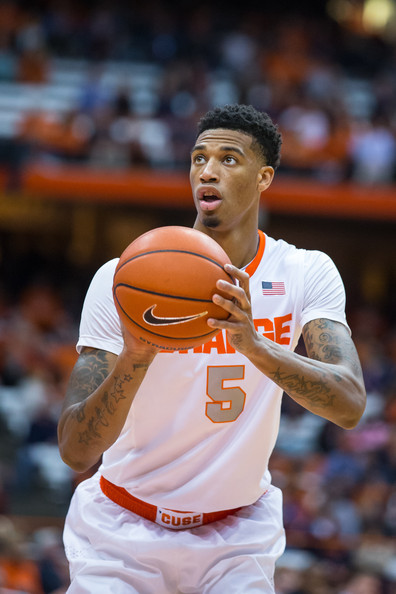
Michael Gbinije might be able to get the triple double, if the stars align correctly.  Gbinije is Syracuse's starting small forward, but he spends a lot of time running the offense at the point.  In two of the last three games, Gbinije has had double digit rebounding efforts.  The Wake Forest game is the closest he has come to a triple double when he had 11 rebounds, 7 assists and 17 points.  

Gbinije's career high in assists is 8, which he did against Long Beach State earlier this year. He had 6 rebounds and 24 points in that game.

10 assists will be tough for Gbinije to get. Syracuse is not a high scoring team, and therefore there is a smaller potential for assists to begin with.   If he had a good night of feeding Trevor Cooney and Rakeem Christmas, and they both had big scoring nights, that could help him a lot. But right now there really are only three scoring threats on the Orange: Cooney, Christmas, and Gbinije, and Gbinije cannot get an assist to himself.  A big game by Tyler Roberson or another Orange player would help.

Gbinije is more likely to get 5-6 rebounds in a game than 10, but he does have that potential.

I do not think he will accomplish the feat.  He does get the playing time, but I think the assists will be out of his reach.  But I will be rooting for him to do it.

Wednesday, January 14, 2015

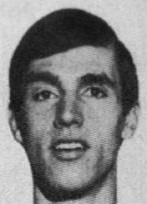
Bill Smith Nets 47

44 years ago today, on January 14th, 1971, Bill Smith set the Syracuse single game scoring record with 47 points against Lafayette.  The closest any Orangeman has come to breaking that record was when Gerry McNamara lit up Brigham Young for 43 points in the 2004 NCAA tournament.

Bill Smith Syracuse Orangemen
Bill Smith
Smith was a fiery tempered center who once punched a referee.  He was an excellent rebounder and a terrific inside scorer. At 6'11" he was the biggest center Syracuse had up to that point in time.  Smith would average 20.9 points and 14.5 rebounds per game for his career.  

On January 12th, 1971 he had 28 points and 30 rebounds in a victory over American University. That was only the appetizer to his big night.  Two days later, Smith would score 47 points in a 106-92 win over Lafayette.  

It was a shootout of the big scorers for both teams. Tracy Tripucka, brother of NBA star Kelly Tripucka, would score 41 points for Lafayette.  Smith would have 27 points at halftime; Tripucka 26.

But the spoils would go to Smith who shot 17 of 23 from the floor, and 13 of 19 from the free throw line.  Smith would also have 19 rebounds in the contest.  

Greg Kohls also had a big night for the Orangemen with 24 points, but all accolades on that evening go to Mr. Smith.

Tuesday, January 13, 2015

Christmas Comes Up Big

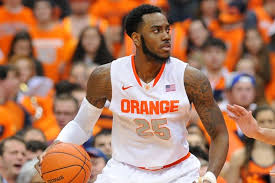
Rakeem Christmas had a career night against Wake Forest, leading Syracuse to a 86-83 overtime win over the Demon Deacons.  Christmas scored 35 points and had 9 rebounds for the game.

Christmas simply overwhelmed Wake Forest for most of the game, on both sides of the court. Though he ended up with only one blocked shot, he altered several other shots by Wake Forest.  Offensively, the Demon Deacons just could not match up to Christmas as he made 12 of 23 shots.

Rakeem Christmas - Syracuse Orange
Rakeem Christmas
Christmas' 35 points were the most points by an Syracuse player since James Southerland scored 35 against Arkansas in November 2012.  This was the best scoring effort by a Syracuse inside big man since Hakim Warrick scored 36 points back in 2005.  The last Syracuse center to score over 30 points in a game was Otis Hill back in 1997 with 34 points against Alabama.  The last Syracuse center to score 35 or more points in a game was Bill Smith, back in 1971, when he set the school record with 47 points in a game.

Christmas had four fouls with about six minutes to go in regulation, and he managed to stay in the remainder of the game and all of the overtime period.  He gave up the defensive baskets rather than foul out, and that was crucial as he was the Orange's best scoring threat from the field and from the free throw line.  

It will be interesting to see how this season plays out for Christmas.  He continues to amaze me each night with the immense improvement in his game. He is so much more fluid offensively than in the past, and is extremely aggressive around the hoop.  The fact that he consistently faces a double team just makes it more amazing.

Monday, January 12, 2015

McCullough Out

On a night when Trevor Cooney blistered Florida State for 28 points and the Orange moved to 3-0 in ACC, there was not too much joy as freshman Chris McCullough injured his knee.

News today is the McCullough has torn his ACL and will miss the rest of this season.

The Orange will move on without McCullough, and all is not loss, as basketball is a team game. But this is highly damaging for a team already thin in the front line.

DuJuan Coleman is out for the entire year, and Chino Obokoh is the only reserve 'big' man the Orange have.  

The Orange need Rakeem Christmas to continue to play aggressive, but when he gets winded or in foul trouble, it will be tough to replace him.  Obokoh had four fouls in the Florida State game in just over five minutes of play, so you have got to believe he has a lot of work cut out for him.

Tyler Roberson can help replace McCullough, and Roberson is more of a natural power forward, so this should help Roberson.  But you do not replace 6'10" athletic players easily and that is what McCullough brought to the court.  He may have been struggling, but he was still a factor on the court.  
B.J. Johnson is going to need to come back from purgatory, and start to play.  He was rebounding well earlier in the season, but his shooting was horrendous and his defensive play in the zone was lacking.  Jim Boeheim will play a player who plays defense but is struggling offensively, but he does not like to play a guy who creates a problem in the zone defense.   

The Orange are going to need Johnson and Obokoh to start to develop.  The perimeter with Cooney, Mike Gbinije, Kaleb Joseph and Ron Patterson will be fine.  And Christmas is playing like an All-American. Let's see which Orangeman will help him out.

The timing for when McCullough can return next year will be interesting.  Conventional timing indicates it takes about a year for a repaired ACL to heal.  Some players do have a faster time line.  Andy Rautins tore his ACL, and missed an entire season.  The upside for Rautins was that he hit the gym hard, added twenty pounds of muscle, and came back a much stronger and better player.  Hopefully McCullough's surgery goes well, and he can have the same success Rautins had with his rehab.

Friday, January 09, 2015

The Most Improved Senior

Conference play has just begun for Syracuse, so there is still a long way to go in the season.  However, at this point in time, Rakeem Christmas has made an amazing jump in his performance from his junior year to his senior year.  This is causing a lot of discussion among Syracuse fans on whether this is the best increase between a junior and senior season.


In 2013-2014, Christmas  averaged  5.8 ppg, and often was pulled early in the game by a frustrated JimBoeheim. In 2014-2015, Christmas is the focal point of the offense, and is scoring 17.3 ppg.  Not only is his production up, but he seems to move with more grace and ease on the court, shows a wider variety of moves, and a more aggressive style. There are still weaknesses to his game, and the tough part of the schedule is still a month away, but Christmas has definitely made huge strides.

How does Christmas compare to other seniors who made great strides their senior year? Chronologically…

In 1919-1920, forward Nick Paul led the Orangemen in scoring with 13.5 ppg, and was the team’s designated free throw shooter. Paul was 8.5 ppg better than runner up Ken Lavin.  He led the team to a 15-3 record.  As a junior Paul played in only four games and scored 10 points.   A rather remarkable performance for a man who had played only 5 games in his career prior to his senior year.  Syracuse won its last 13 games of the season, and Paul was the leading scorer in each game.

In 1951-1952, guard Bucky Roche was second in scoring on the team with 14.0 ppg.  His junior year he had scored 4.6 ppg.  Roche’s highlight of the season was a 35 point game in a tight win over rival Cornell.

In 1968-1969, forward Bob Kouwe was second in scoring with 14.0 ppg, and had 6.5 rebounds per game.  He had only 4.0 ppg and 2.8 rpg in a junior season that was cut short by a team suspension.  Kouwe would have a career high 27 points in a one point win over rival Colgate.

In 1980-1981, center Danny Schayes led the Orangemen in scoring and rebounding with 14.6 ppg and 8.3 rpg.  He shot 82% from the free throw line and 58% from the floor.  He had only 5.9 ppg and 4.5 rpg his junior year.  Schayes had always been a fundamentally sound player, but he was stuck behind Roosevelt Bouie for three years.  Boeheim tried a twin tower approach with Schayes and Bouie both on the court, but that did not work well as neither player was suited for the forward position.

In 1986-1987, guard Greg Monroe would increase his scoring from 4.6 ppg to 12.9 ppg, along with doubling his rebounding and assist efforts.  Monroe could always play, but he lacked the playing time being stuck behind Pearl Washington and Rafael Addison.  The unknown that Monroe brought to the game was his three point shooting. This was the first season of three point shooting in the NCAA, and Monroe proved to be very good at it, hitting 43.9% of his shots. That, along with his senior leadership, was a great factor in allowing the Orangemen to make a run at the National Championship.

In 1995-1996, point guard Lazarus Sims would develop into a fantastic playmaker, averaging 7.4 assists per game, along with 3.7 rpg. He wasn’t counted on to score, averaging only 6.3 ppg, but he shot well enough (36% from three point range and 75% from the free throw line) to keep teams honest.  Sims would help guide the Orangemen to the National Championship game against Kentucky, and his playmaking was the second biggest factor behind big John Wallace.  Sims only played 441 minutes his junior year, averaging 2.6 apg, 1.4 rpg, and 3.0 ppg, as he sat behind Michael Lloyd and Lawrence Moten.

In 2000-2001 point guard Allen Griffin would dwarf his junior year statistics.  He had 10.8 ppg, 6.5 apg, and 3.3 rpg, versus 3.0 ppg, 1.7 apg, and 1.1 rpg.  However, Griffin’s career was strange, as he was a healthy but seldom used junior player who was stuck behind guards Jason Hart, Tony Bland, DeShaun Williams and swingman Preston Shumpert.  As a sophomore, Griffin had been a starter and had a decent season, so while his senior year was a huge leap from his junior, it was not a huge leap from his sophomore.  Griffin did have to huge games his senior year; he recorded a triple double in a win over Pitt, and the next game he would score 31 points in a 2 point win over St. John’s.

In 2006-2007, forward Demetris Nichols went from having a good junior year to an excellent senior year.  Nichols had 13.3 ppg as a junior, but he rose that to 18.9 ppg as a senior.   Nicholas became more efficient as he improved his shooting touch, and was more prolific. He increased his three point shooting from 36% to 42%, and his free throw shooting from 68% to 85%. Nichols would score 37 points and have 10 rebounds in a two point win over St. Johns.

In 2010-2011, forward Rick Jackson made significant strides in his play, even if the statistical numbers weren’t as strong as some other candidates.  Jackson increased his scoring from 9.7 ppg to 13.1 ppg, and his rebounds from 7.0 rpg to 10.3 ppg.  Defensively he became the Big East Defensive Player of the Year.  He was far more consistent offensively, as opposed to his junior season where he often disappeared. 

If I were to choose a player, prior to this season, I would have to go with Lazarus Sims.  I did not see the first three players I mentioned, and statistically speaking, Nick Paul had the best improvement of any Syracuse player ever, especially in the context of his era.  But I did not see him play.

Sims ran the offense spectacularly his senior year, and with his size was a strong defensive presence at the top of the key.  This from a player that almost transferred earlier in his career, and a player that Jim Boeheim was shaky enough about that he recruited a junior college player (Lloyd) to play the point instead.  The fact that Syracuse went to the national championship game speaks a lot about Sims improvement.

Many of the players listed above may not have benefited from significant improvement in their play, but rather from finally getting the opportunity to play. That is always tough to tell. Christmas is a little bit clearer because he has been given the opportunity to play, and never took hold of it.  He has been a starter his whole career, but has also been the victim of many quick hooks.


If Christmas keeps up his pace, and the Orange make some noise in the post season, I would be apt to make him the most improved senior ever.  We will have to see how it plays out.
Saturday, January 03, 2015

It's a Win but Yuck

The good news is the Orange won today 68-66 to get themselves to 10-4 and 1-0 in the ACC.  The bad news is they blew a nineteen point lead, and could not seal the win with their free throw shooting.

Syracuse led by nine points, 62-51, with 2:22 left to play.  They would go to the free throw line sixteen times from that point on, and would make only six of them.  Those ten missed free throws almost cost the Orange the game.  

We cannot even pin the poor free throw shooting on one player; this was truly a team effort:

Ron Patterson, 2-6
Michael Gbinije, 1-4
Tyler Roberson, 1-2
Trevor Cooney, 1-2
Rakeem Christmas, 1-2

In that same time period, the Hokies made three 3-point baskets, two 2-point jumpers and a layup for 15 points.  The Hokies had a chance to win the game with a last second three point basket, but fortunately for the Orange that the Hokies had to rush the shot and the Orange played good defense on the play.

But, it was a win, a road win at that. And a win is a win.

As an interesting note of trivia:  Ron Patterson played 183 minutes of collegiate basketball, and was in his 22 game, before he made his first free throw.  

Thursday, January 01, 2015

Non-Conference Rankings

Syracuse has completed its non-conference schedule with a record of 9-4.  They have eighteen ACC conference games coming up to help build their resume for the NCAA, along with the ACC tournament games.  The Orange will have their work cut out for them, and will have the opportunities to do so.

The ACC currently has five teams in the AP Top 25:  #2 Duke, #3 Virginia, #5 Louisville, #14 Notre Dame and #19 North Carolina.  Syracuse will play Duke twice, and each of the other teams once, so as it stands rights now they have six opportunities to beat ranked team.  That will likely change as the season progresses, as teams move up and down the rankings, but it gives a good starting point.

The initial part of the ACC schedule for Syracuse is a favorable one, and the Orange will need to take advantage of it because the back end of their schedule is murderous.  Syracuse plays its first seven ACC games against non-ranked teams, and four of those are at home. The last seven games of their ACC schedule has them playing five games against teams ranked 14 or higher, including Duke twice. 

Syracuse’s 9-4 non-conference record is not going to help them, but it is not going to hurt them too much. They did not have any terrible losses on their schedule, with all four wins being against major conference schools.  KenPom.com has Villanova at #6, St. Johns at #23, California at #72 and Michigan at #74.  Iowa gets credit for being an impressive win as it is a team from a major conference and KenPom has them rated #33, but none of the other wins are notable.

A 9-4 non-conference record is the 2nd worst record since Syracuse joined a conference in 1979-1980.  In 1981-1982, the Orangemen were 8-4 with non-conference losses to unranked St. Josephs, Fordham, Ohio State and #4 ranked DePaul.  This was the team led by triumvirate of Leo Rautins, Erich Santifer and Tony Bruin, and the team finished 7-7 in the Big East, 16-13 overall with an NIT bid.  Not a good sign for this year’s team.

The Orange have been playing much better since their loss to St. John’s.  Trevor Cooney has found his shooting touch and diversified his game.  Michael Gbinije has improved his all-around game, plus improved his shooting, and Rakeem Christmas has cut down on the silly fouls giving him more playing time and remained a consistent steady inside force. 

The parts are coming together but the Orange need more progression from others players.  Chris McCullough has to learn how to handle being pushed around.  Kaleb Joseph, or Ron Patterson, needs to step up and take control of the point guard position.  Either B.J. Johnson or Tyler Roberson has to become more reliable on both the defensive and offensive end of the courts. 


It all starts with the Virginia Tech game this Saturday. Go Orange!

Wednesday, December 31, 2014

Top 10 Highlights of Syracuse Basketball in 2014

Happy New Year to all the Orange fans out there.  As 2014 comes to close, here are my top 10 highlights from Syracuse basketball for the year.

  1. Syracuse beating Duke 91-89 in overtime on Feb 1st before an NCAA record crowd 35,446.
  2. Tyler Ennis’ 35 foot game winning basket against Pitt for a 58-56 victory at the Peterson Center on February 12th, extending the Orange's winning streak to 24 games.
  3. Syracuse’s school  record 25 game winning streak set against North Carolina State on Feb 15th.
  4. Syracuse reaching #1 in the polls on February 3rd, with the Orange being 22-0.
  5. Jim Boeheim throwing his coat and being ejected against Duke on Feb 22 at Cameron Indoor Arena.  It was Boeheim’s first career ejection, as he argued that C.J. Fair’s game winning shot should have counted; instead Fair was called with charging.
  6. Trevor Cooney scoring 33 points against Notre Dame on February 3rd.  He was 9 of 12 from three point range, and 11 of 15 from the floor in the 61-55 win.
  7. Syracuse beating Western Michigan 77-53 in the first round of the NCAA Tournament behind Trevor Cooney’s 18 points.
  8. Syracuse beating Miami 49-44 on January 4th, behind C.J. Fair’s 15 points. This would be Syracuse’s first game in ACC conference play.
  9. Syracuse beating North Carolina 57-45 on January 11th before 32,121 fans at the Carrier Dome. The Orange would lead by as much as 19 points with four minutes to play.
  10. Syracuse beating Kennesaw State 89-42 on November 14th to start the Kaleb Joseph & Chris McCullough era, kick off 115th season of Syracuse basketball and Jim Boeheim’s 39th season as head coach.


Thursday, December 25, 2014

Merry Christmas!

I wanted to wish all the Orange fans out there a very Merry Christmas! I hope you stockings were full of neat stuff, and that Old Saint Nick came down that chimney with a bagful for you and yours.

Appropriately, the only way to wish a truly Orange Christmas is:


Wednesday, December 24, 2014

Shaking Away Preconceptions

I think sometimes we as fans let our preconceptions of what a player or coach does cloud the reality of what we see.  There is a common perception among Orange fans that Jim Boeheim always plays a tight rotation of 7 players, and he is unwilling to change.  

Statistically, that is not true.  And surprisingly, we only have to go back two and three seasons to see contrary situations.

Using a guideline of players who played 10+ minutes a game, and who played in virtually all of the games they were eligible to play in (where they were not limited by injury of suspension), here is a breakdown from 1989-1990 to 2013-2014 of the number of players in Boeheim's 'rotation' (data from OrangeHoops)

2013-2014: 7
2012-2013: 9
2011-2012: 9
2010-2011: 8
2009-2010: 7
2008-2009: 8
2007-2008: 7
2006-2007: 7
2005-2006: 7
2004-2005: 8
2003-2004: 9
2002-2003: 8
2001-2002: 8
2000-2001: 7
1999-2000: 8
1998-1999: 8
1997-1998: 7
1996-1997: 7
1995-1996: 7
1994-1995: 8
1993-1994: 7
1992-1993: 8
1991-1992: 7
1990-1991: 7

1989-1990: 7

Over those 25 seasons, Boeheim did employ a seven man rotation thirteen times.  But, that means twelve times he employed a larger rotation.  Nine times he had an eight man rotation, and three times he had a nine man rotation. In 2012-2013 and 2011-2012 he had the nine man rotations... very recent indeed!

I do no think there is any doubt that Boeheim likes to play his primary five as much as he can.  And clearly a seven or eight man rotation is his norm.  He does however adjust to the talent he has.

Boeheim appears to be unwilling to play a player who has not proven himself in practice. He does not appear to be a coach who wants to play a guy 'just to give him experience'. Instead, he always works to put his team in the best position to win for that game.

It is true that Boeheim's bench will shrink during truly big games.  I would submit however, that is true for most if not all coaches. You play your best players when you need to play your best players.

In 1995-1996 Syracuse played a tight bench all season, and Kentucky, who was the dominant favorite that season was touted for the incredible depth of the team and how masterful Rick Pitino was for playing so deep into his bench.  And Kentucky did play 10 deep all season long; no player on that team averaged more than 27 minutes a game.

In the championship game, Syracuse played seven deep as they had done all year. But look at what Rick Pitino did.  Pitino, who is a great coach, went only eight players deep, and four of his starters played 27 or more minutes. Tony Delk played 37 minutes and Anthony Epps 34.

Part of that was because it was a real big game for Kentucky, and Pitino wanted his best players on the court (i.e. just like Boeheim). And part of that was that the game pace and tempo, which was dictated by Syracuse, not Kentucky, allowed Pitino the opportunity to keep his starters in the game longer.  However, read that last point again.  Pitino, in one game because of tempo, kept his starters in longer.  Boeheim plays with that tempo all 35+ games all year.  And by the way, which set of players do you think were less fatigued in that game? The guys who averaged 35-38 minutes a game all year, or the guys who averaged 22-27 minutes a game?  My money is on the guys who are used to playing those minutes.  

But I digress.  

The original point was that Boeheim never plays more than seven deep (which is false), and Boeheim won't change or adapt (which is also false). When Boeheim has the talent, he plays the talent, and when he has a small set of talented players, the rotation is smaller.

An interesting side note: back in 1977-1978, during the Louie 'n Bouie era, Syracuse went 11 players deep (10 if you don't want to count Marty Headd as a regular), and 12 players on the team had enough quality time per game they played to average 3.4 ppg or more.

Monday, December 22, 2014

The Orange Are Improving

The Orange are improving, which provides me with some sense of relief.  It seemed early in the season that the team was never going to improve.  The 49th consecutive win against Colgate came rather easily, and with this team, prior to tip off, it may not have been easy. But there was nothing to worry about.

Trevor Cooney has gotten his game back on track and continues to keep himself involved in the offense as a playmaker, not just a shooter.  That type of play can only continue to help the Orange as the season progresses. It will take pressure off of Kaleb Joseph, help open up the middle of the court, and force defenders to guard Cooney honestly.

Rakeem Christmas has proven himself to be a strong inside presence this year both offensively and defensively.  The key will be how many minutes can he stay on the court without getting into foul trouble.  

The sophomore class continues to be inconsistent, but bright spots due appear. Ron Patterson had his opportunity to shine with a nice game against Colgate (13 pts on 3-6 three point shooting).  Proper perspective would remind you that it was against Colgate; however, Patterson has done very little recently and has been a healthy non-play in some of those games. So it was nice to see him get some quality time.

Chris McCullough seems to be regressing. He can definitely rebound but offensively he is really struggling, and defensively he isn't always in the right position.

The team is improving, and it will be interesting to see how much better they can get.

I am more concerned with the defense than the offense right now.  The bright side is that Jim Boeheim has found the team does reasonably well with their press defense, so there is a defensive scheme that works. The dark side is that they team is struggling with its bread-and-butter zone defense.  It seems to me that there is poor backside rotation covering the holes, and the wings are still slow at getting out on the shooters.  I am not sure that is something that can be fixed quickly in the season.  It can improve, but the key to a zone defense is everyone moving as one, and not allowing gaps to occur.  It is a very difficult defensive concept, one that takes time, and I think having only two returning starters is hampering that development.

It is good however to be going into the Christmas holiday with a recent victory.

Go Orange!

Tuesday, December 16, 2014

It's Going To Be a Rough Year

Here's where the 2013-2014 Syracuse Orange are, summed up fairly well by a man who should know:
"This isn't like the last six years. We're going to struggle to win a game. We're going to struggle to win a game, any game that we play. This game is not going to beat anybody that's any good if they don't play better. That means all 18 games in the ACC. I don't care if somebody thinks, oh, they're not that good. They're good enough. Trust me. We have to play a lot better, we have to get better and we have to figure that out and we'll see. Again, I don't know, I wouldn't want to be overly-confident about that right now because we're not talking about the difficult things we'd like to try to do. We're trying to get the basic essentials down and that's not good at this stage."

Syracuse coach Jim Boeheim at the Louisiana Tech post game press conference, December 14th, 2014.

Sunday, December 14, 2014

A Flash of GMac

For at least one night, Trevor Cooney did a very good Gerry McNamara impression.  I am not referring to his three point shooting, though he was 4 for 8 from three point range.  I am talking about how all the elements of the game against Louisiana Tech were similar to GMac.

Gerry McNamara was a terrific shooter out of Bishop Hannon High School in Scranton.  Shortly before the 2002-2003 season began, Syracuse's projected starting point guard Billy Edelin found out he was ineligible for the first 12 games of the season.  McNamara assumed that role, and became the de facto point guard for the Orangemen.

McNamara would drive to the hoop, he would get the ball into the Carmelo Anthony, and let Anthony make the play, or get himself open so that Anthony could kick it back out.  McNamara had a knack for jumping the lane and getting the necessary steals.  During the closing minutes of close games, McNamara would hold run the clock down, often forcing opposing teams to foul him so that he could got to the free throw line with his 90% accuracy and seal the game.  

Trevor Cooney played that type of game against the Bulldogs earlier today.  The 25 point effort and the four of eight three point shooting are the obvious highlights.  The three steals and the 5 of 5 from the free throw line were critical.  Cooney brought the ball up the court during most of the games crunch time, taking the pressure off of freshman Kaleb Joseph, who struggled with eight turnovers.  

Cooney had no turnovers.  He demonstrated leadership on the court, provided a steady hand, and was the vocal encouragement on the court.  

There were some mistakes in the evening for sure.  And the Orange still had to come down to the wire to win the game.

But for one night this season, I felt like I was watching Gerry McNamara on the court. And that was a nice thing.

Saturday, December 13, 2014

Missing Grant

A front line of Rakeem Christmas, Jerami Grant and Chris McCullough would be quite impressive and formidable.  The Orange could have had the line up if Grant had not jumped early to the NBA last June.

That would have provided a front line with a lot of length, quickness and vertical space, perfect for Jim Boeheim's zone defense.  Grant was improving offensively last season, and with the improved offensive skills for Christmas plus the arrival of McCullough, there would have been a lot of ability to score up front.  It would get crowded at times, but I think McCullough would have been comfortable drifting a little further away from the hoop.  Plus, with the foul trouble Christmas has had each game, there definitely could never be too much depth up front.

The presence of Grant would not help the perimeter situation; with the exception of Cooney who draws a lot of defensive attention, most of the perimeter players are seeing good three point opportunities frequently.  But I think the addition of Grant on the back line would allow for more steals and force turnovers, and that would improve the fastbreak opportunities.

I had mentioned back in June that I thought it was a mistake for Grant to leave early.  I believe he left a lot of money on the table.  I would imagine that his family is not in dire financial need, as his father is former NBA player Harvey Grant.  Another year of college would have given him more time to improve his draft stock and more playing time per game to work on his skills.

An early season injury hampered Grant's start this year in the NBA.  He is healthy now, and playing for the worst team in the NBA in the Philadelphia 76'ers (and one of the worst in NBA history). He's playing 9-12 minutes a night, which isn't bad... but he could be playing 35+ minutes for Syracuse.  And again, I'll go back to my original statement... it's all about the money.  He was worth more if he stayed.

I wish I could argue that Tyler Ennis should have stayed. Without a doubt he would be helping the Orange out early this season. He would bring in another perimeter shooter, and he would run the offense, and let Kaleb Joseph mature and learn.  Ennis did tend to have a tendency to play it safe too much, and I think he missed opportunities to push the ball, but the results last year were pretty good.

Financially, Ennis made the right move. He is not getting the playing time, but he is getting the practice time.  He definitely would have improved with more playing time at Syracuse, but his draft stock wasn't going to change significantly in my opinion.

Sunday, December 07, 2014

Shooting Woes

The Orange seemed stunk in a season long slump with their three point shooting, with a 20.9% accuracy for the season. The Syracuse team has not been shy about shooting beyond the arc, having taken 129 shots over the first 8 games, an average of 16 a game.  Unfortunately, they are making about 3.3 a game.

Trevor Cooney has been the lightning rod for the most criticism.  In part that is fair, as he is a junior, one of the most seasoned players on the team, and came to Syracuse with a reputation of being a perimeter shooter.  His bombing of Notre Dame last season showed he could do it when he lit up the Fighting Irish for 9 three point baskets on 12 attempts on his way to a 33 point night.  Cooney has hit only 13 of 46 attempts this season, for a success rate of 28.3%.

Cooney is, however, the best three point shooter on the team.  I am not just talking from a observation perspective.  Statistically, his 28.3% is the best on the team... and by a large margin. Here is the rest of the crew:

B.J. Johnson:   5 of 23 for 21.7%
Kaleb Joseph:   3 of 14 for 21.4%
Michael Gbinje:   3 of 21 for 14.3%
Ron Patterson:   2 of 18 for 11.1%

As a group, that foursome is 13 of 76 for 17.1%.  

All hope should not be lost.  It is highly unlikely that the Orange as a team are that bad at shooting the three, and things should come around.

Here are a list of the five worst three point shooters in Syracuse basketball history, minimum 30 attempts:

Paul Harris:  22 of 98 for 22.4%
Damone Brown:  20 of 89 for 22.5%
Elvir Ovcina:  37 of 153 for 24.2%
Louis McCroskey:   36 of 141 for 25.5%
Josh Wright:  34 of 120 for 28.3%

To give some perspective of how bad those five were as three point shooters, consider that Stephen Thompson, one of the all time great Orangemen, but a horrendous three point shooter, is only 9th worst at 30.3% (26 of 86).  So the five worst shooters are pretty bad.  

Right now, ALL five Syracuse perimeter shooters would be worse than #5 Josh Wright, and four would be worst than Paul 'I couldn't hit the broadside of a barn' Harris.  So unless Jim Boeheim coincidentally recruited the five worst shooters in Syracuse history at the same time, it is highly unlikely the shooting performance is indicative of their actual ability.

Trevor Cooney is an enigma. He is a 34% career shooter, and has been a disappointment for all three seasons, with high expectations based on Boeheim's comments about his ability.  Opposing defenses are keying on him, but even when he gets open, his shot is not falling. 

We would expect the Orange shooting to start to regress to the mean at some point. They aren't likely to ever be a great perimeter shooting team, but they should be in the 30-33% range, at a minimum. Just keep taking the shots.

Or, perhaps give walk-on Carter Sanderson more playing time (playfully said).  Sanderson is a graduate student at Syracuse, and is on the team because he still had a year of eligibility left after completing his undergraduate work at Lipscomb University.  Sanderson made 32.4% of his three point shots at Lipscomb, 55 of 170.  

Anyhow, there will be a brighter future in the team's shooting. I just hope it is sooner than later.

Thursday, November 27, 2014

Happy Thanksgiving 2014

I would like to wish you all a Happy Thanksgiving!

I am thankful for having the privilege for being a Syracuse basketball fan, and for all the high and low moments every year.  There is joy in watching the team grow and develop each year.

I am thankful to have had the privilege to see Syracuse win a National Championship in 2003, and to see Hakim Warrick fly out of no where for one of the greatest game winning blocks ever.  I am thankful to have been able to watch the team win a dramatic 6 overtime game against UConn in the 2009 Big East Tournament, with players on both teams playing their hearts out.

I am thankful to have been able to attend the Syracuse / Boston College game with my dad on January 21, 1984, and watch a dynamic freshman Pearl Washington sink a half court shot to beat Boston College.

I am thankful for having been able to go to the Syracuse / Georgetown game in 1990 with my good friend Vady, and watch the Orangemen storm back from a big half time deficit to beat the Hoyas in overtime 89-87.  That may have been the loudest game I have ever attended at the dome.

I am thankful to have watched the 1996 Championship game with John Wallace carrying the Orangemen in the post season.  The Orangemen lost the game, but I was able to view it with my 3 month old son sitting on my lap.

I am thankful for having a wonderful family and having the time to share with them.  I am thankful that I have a home to live in, and always have food on the table. That I have friends to share the good times with, and those to support me in the bad times.  I am thankful the bad times are so far and few. I am thankful to have the lord in my life to provide me with inspiration each and every day.

Thanks thanks to all the Syracuse fans out there.

Friday, November 21, 2014

Searching for that Big Time Scorer (30 points)

Amidst Syracuse’s scoring woes in this young season, I find myself longing for a big time scorer on the team.  The type of player who could carry the team for a night, with a 30+ point effort.  It may seem that Syracuse does not have that type of player right now, but that would only be if you have a short memory.  Trevor Cooney bombed Notre Dame for 33 points last February 2014 as he hit 9 of 12 three point shots.   Of course, we all know that Cooney can shoot; it is just that he can be very streaky and inconsistent and he is currently in the middle of a long slump.

Overall, 58 different Orangemen have scored 30+ points in agame; this has been accomplished 179 different times.

The first time was in 1904 when George Kirchgasser scored 30 against Jenners Prep.  Kirchgasser scored all 30 from the floor; he took no free throw shots in the game.  Because it was an earlier era, it isn’t recognized today as an official accomplishment.

The first official 30+ point game by an Orangemen occurred in 1943 when Bob Shaddock scored 30 over rival Colgate.

The Syracuse record for points in a game is 47 by Bill Smith.  Smith shot 17 of 23 from the floor, and made 13 free throws in a high scoring game against LaFayette.

Dave Bing scored 30 or more points in 20 different games, or roughly 26% of the varsity games he played at Syracuse.  That’s just in case you ever really wondered about the greatness of Bing.

Sharpshooting Greg Kohls is next on the list with 14 games with 30+ points.  The amazing thing about Kohls was that he barely played his sophomore season (freshman couldn’t play in his era).  He played 54 varsity games his junior and senior season as like Bing, scored 30+ in 26% of the games. Kohls was a terrific perimeter shooter; who knows how many 30+ point games he would have had if there had been a three point shot in that era.

Billy Owens is third with 10 games with 30+ points.  Owens was the first player under Jim Boeheim to average 20+ points a game. 7 of those 10 games occurred his junior season, after Derrick Coleman and Stephen Thompson had graduated.

30 point games have occurred everywhere.  94 times they have occurred at home (53% of the time).  59 occurred at the opponent’s home court.  8 occurred in a mid-season tournament, 2 in the post season NIT, 1 in the ECAC, 7 in the Big East tournament and 8 in the NCAA Tournament.

It may be surprising to see what players never accomplished the feat.  Derrick Coleman, Syracuse’s second all-time leading scorer never scored 30 points in a game.  Part of that reason was that Coleman was always surrounded by other great scorers in Sherman Douglas, Rony Seikaly, Stephen Thompson and Billy Owens.  But Douglas, Seikaly and Owens all did it.

Stephen Thompson, Syracuse’s 7th all-time leading scorer never hit 30.  I’m sure besides playing with other great scorers, that the inability to make free throws and a three point shot kept Thompson from that mark.  Thompson was a great scorer though; I’m not sure if there was ever a better scorer in the Boeheim era.

C.J. Fair, who finished as Syracuse’s 15th all-time leading scorer, never did it. Nor did Brandon Triche at #17 (though his uncle Howard did it), or #18 Todd Burgan, or #22 Jason Hart.
There have likewise been some surprising players who have had the unexpected big nights.

NFL Hall of Famer Jim Brown had the talent on the basketball court, as well as the gridiron and the lacrosse field. He was second on the team in scoring his sophomore season with 15 ppg, and he would score 33 against Sampson Air Force Base that winter. 

In January 1952, Bucky Roche scored 35 at Cornell.  The senior guard was second in the team in scoring with 14 ppg; but he had scored only 121 points in his career before his senior year.

In December 1962, sophomore guard Phil Schoff would score 30 points against Cornell in a big loss.  Schoff would finish the season as the teams third scorer at 10.4 ppg.  Schoff would lose his starting position his junior year with the arrival of Dave Bing, Sam Penceal and Chuck Richards, though he would remain a valuable reserve.

In December 1986, senior forward Howard Triche would score 31 points in win over Northeastern. Triche was the fifth leading scorer on the team that year, and that was the only time in his career he would lead the Orangemen in scoring for a game.

The most surprising was probably Gene Waldon.  Waldron put up 40 points against Iona in the 1983 Carrier Classic. Waldron did this in the non-three point era.  He was the fifth leading scorer on the team that year, averaging 9.2 ppg and Waldon had never been a big scorer before.


If not for Waldron, the most surprising may have been senior Allen Griffin.  Griffin would score 31 in a double overtime win against St. John’s .  He as the fourth leading scorer on the team at 10.8 ppg, and had averaged only 3 ppg his junior year.  His method of scoring 31 points was highly unusual too. Griffin only made 5 of 9 baskets that night.  However, 3 of those 5 made field goals were 3 point baskets.  And he was sent to the free throw line 22 times where he made 18 of the them.

Saturday, November 15, 2014

2014-2015 Season of Questions

The 2014-2015 Syracuse basketball season should be an interesting one.  It has been quite a long time since the Orange entered a season with so much unknown about the team.  The expected departure of C.J. Fair and Baye Moussa Keita, along with the early departure of Tyler Ennis and Jerami Grant have left the Orange with a lot to be replaced.

DaJuan Coleman continues to remain hurt, and the most experienced returning sophomore Tyler Roberson only played in 20 of the teams 34 games.  The only 'known' quantities are returning starters Trevor Cooney and Rakeem Christmas, and reserve swingman Michael Gbinije. 

Cooney and Christmas are both inconsistent players, with flashes of outstanding play, and periods of disappointing play.  Normally on any given season, you can find some dependable returning upperclassmen, or at least one star to rally the team around, but that is not the case this year.

The Orange are going to need Cooney and Christmas to both be more consistently good in their play, and Christmas will need to be a bigger part of the offense.  The freshman Chris McCullough and Kaleb Joseph are going to have to contribute quickly, and the sophomore trio of Roberson, B.J. Johnson, and Ron Patterson are going to have to be ready to play. Those last five mentioned players all have a lot of potential; it will be curious to see who has matured and developed since last year.

The last time the Orange had a season with this much doubt would likely have to be 1983-1984.  This was Pearl Washington's freshman year; in restrospect it seems funny to question that year, but there was concern if the Pearl's playground style would translate to the NCAA, and how good would he really be.  Plus, regardless of his talent, he was a true freshman, and the early 80s was not an era where most freshman excelled.

Syracuse was coming of a good (but not great) 21-10 season, with 9-7 in the Big East.  The trio of Erich Santifer, Leo Rautins and Tony Bruin had all graduated. Those three had been starters since their sophomore season.  Gene Waldron and Andre Hawkins were returning players, but neither was a star. Waldon was a competent point guard, but most of the offense had previously gone through Rautins as a 'point forward'.  Hawkins was limited on offense, undersized as a center, and prone to foul problems.  Raf Addison was the key reserve returning, and he had shown some promise in his bench role; however Addison wasn't a highly recruited player, so there were not big expectations for him

Things worked out well for the Orangemen that year.  The Pearl was as good as advertised, if not better. Addison turned into a star player, and led the team in scoring with a solid game of mid range jumpers and interior play.  Senior Sean Kerins showed that he had learned something after four years on the bench behind Rautins and Bruin, showing a combination of perimeter shooting and rebounding.

Hawkins learned to be comfortable at the post, and became a reliable 10 point scored, and sophomore Wendell Alexis developed into a very important sixth man backing up the forward and center positions.  The Orangemen would go 23-9, 12-4 in the Big East, and actually improved from the previous year.  

You could argue the 2002-2003 season had as many question marks.  The team had lost leading scorers Preston Shumpert and DeShaun Williams, and it was a team that had collapsed and had missed out on the NCAA tournament, having to settle for the NIT.  However, the team did have three returning starters in Kueth Duany, Hakim Warrick and Craig Forth.   Duany was a senior, and Warrick had played very well down the stretch, including in the NIT tournament.  

Plus the Orangemen the highly touted Carmelo Anthony joining the team, along with highly rated Billy Edelin, and a scrappy sharp shooting guard Gerry McNamara.  The team definitely turned out to be much better than anyone could have expected; winning Syracuse's first National Title one season after being in the NIT was definitely a tremendous feat.  Anthony turned out to be as good as he was touted, and Gerry McNamara was much better than anyone could have anticipated.  Warrick had improved tremendously, as had classmate Josh Pace, and Duany was a solid senior.  The Orangemen unexpectedly did not have the services of Edelin for most of the regular season, but the team excelled.

So anything could happen in the 2014-2015 season. Jim Boeheim does have a good track record of exceeding expectations when the team is low rated; they are starting this year at #23 in the country.


Tuesday, November 11, 2014

Happy Veterans Day 2014

On this Veterans day, as I have done each year past, I would like to thank all those who have served our country, putting their lives on the line to do those tasks that need to be done. The Orange basketball team has had its share of veterans over the decades. And has been tradition at OrangeHoops, I would like to recognize those former basketball Orangemen who did serve. I acknowledge this is not a complete list; only those I know of (each year I add a few more). I imagine more Orangemen were in the service that I am omitting; if so, please post a recognition here! Also please feel free to recognize any other veterans in the comments.

In World War I, the following served:
Albert Ackley
Bradley Barnard
Ross Bibbens
Meyer Bloom
Jim Casey
Ed Cronauer
John Cronauer
Charles Fasce
Russ Finsterwald
Loyal Greenman
Ken Harris
Ted Huntley
Bernie Kates
Ken Lavin
Nathan Malefski
Danny Martin
Walter ‘Dutch’ Notman
Walter Peters
Elias Raff
Billy Rafter
Horace Ruffin
Courtland Sanney
Clifford Steele

In World War II, the following served:
Jim Ackerson
Earl Ackley
Lou Alkoff
John Balinsky
John Beaulieu
John Beck
Leo Canale
Dick Casey
Larry Crandall
Wilbur Crisp
Dan DiPace
Les Dye
Alton Elliott
John Emerich
Bill Estoff
Bob Felasco
Paul Ferris
Billy Gabor
Ed Glacken
Joe Glacken
Marc Guley
Mark Haller
Lew Hayman
Bill Hennemuth
Bill Hoeppel
Tom Huggins
George Jarvis
Ed Jontos
Walter Kiebach
Jim Konstanty
Stan Kruse (Kruszewski)
Glenn Loucks
Guy Luciano
Saul Mariaschin
Bob Masterson
Paul McKee
Don McNaughton
Tom McTiernan
Francis Miller
Joe Minsavage
Andy Mogish
Roy Peters
Hank Piro
Paul Podbielski
Edward Pond
Phil Rakov
Joe Rigan
John Schroeder
Bill Schubert
Bob Shaddock
Wilmeth Sidat-Singh
Red Stanton
Mike Stark
Chester Stearns
Bobby Stewart
Joe Sylvestri
Charles Taggart
Ray Tice
Joe Weber
Bill Wyrick

In Korea the following served:
Reaves Baysinger, Jr
John Beaulieu
Paul McKee
Paul Podbielski
Fred Serley

In Vietnam, the following served:
Reaves Baysinger, Jr
John Beaulieu
George Crofoot
Rick Dean

The following were veterans who served but were fortunate to miss a war era:
Art Barr
Mel Besdin
Rudy Cosentino
Roy Danforth
Ronnie Kilpatrick
George Koesters
Tom Jockle
Jack Malone
Frank Reddout
Chuck Steveskey

Four of the aforementioned players deserve special note, as they sacrificed their lives in the line of duty.

Wilmeth Sidat-Singh was a member of the Tuskegee Airman, and was killed in a training accident when his plane crashed into Lake Michigan in 1943.

Charles Taggart was a member of the US Navy serving aboard the USS Frederick C. Davis, and was killed when his ship was torpedoed by a German U-Boat on April 24, 1945. Taggart and 115 crew members perished.

John Cronauer was killed in World War I in 1918.

Joe Minsavage was killed in World War II on June 19, 1943 when his ship was attacked and he was lost at sea.